Hellbender Race Report

I had told my friends for years that I wasn’t going to do a hundred mile race. Each summer, I ran a fifty mile race, and each summer, I insisted afterwards that was the perfect distance for me - a full day of racing without blurriness of sleep deprivation.
That changed last July when my friend decided he wanted to qualify for Hardrock and asked me to coach him. There are only fourteen races in the United States that get you in to the Hardrock lottery, and all of them are one hundred miles or longer. The race that worked best with our schedule (and wouldn’t force me to go back to Cruel Jewel) was the Hellbender 100 in Black Mountain, North Carolina.
We volunteered at the Looking Glass 100k and were on the course as fans for the Heartbreaker 50M, so we had the opportunity to get to know a few locals who would be racing with us, and I also had a good luck of find a group of friends within a mile of me (nine hours away from Black Mountain) who had signed up to run Hellbender. This post will focus on the race itself, but it would be very misleading to say that those connections didn’t play a huge role in how much I enjoyed preparing for and running the race.
I enjoy picking a book (or series of books) to connect to my training process each year, and this year, as I ventured into the unknown territory of running through the night, I went with Ada Palmer’s Terra Ignota series. I won’t discuss the books themselves to avoid spoiling them, but most of the headers that follow will be from the series.
‘What do you believe in?’ ask whole sequences of kings to Icelandic wanderers in sages. ‘Ek trúí á shálfan mik’, runs the traditional response, ‘I believe in myself’. The Road to Middle-Earth, Tom Shippey
My goal for the race was just to see how far I could push into the experience, so I went with no poles (the race had around 20,000 feet of elevation gain), no phone (I had it with me as part of the required gear, but left it turned off), no pacer, and no way to track the distance I’d run besides the signs at aid stations. I definitely wanted to be toward the front of the race, but the plan was to stay focused on enjoying the effort and competing with the course rather than shooting for a certain place or pace. I wanted my attention fully on the race I was running and on how to best handle the challenges that it would present.
‘My universe does not have time’ - Miles 1 to 19
This was the least nervous I have ever felt at the start of a race, so I could just enjoy the moment at the starting line and take some pictures with the different groups of runners I knew. The course started with about a mile on a wide gravel road before making a sharp, steep right turn up onto the first trail. I kept it pretty conservative on the opening stretch of road, fiddling with the red light that we were supposed to wear on the roads with potential car traffic, before passing a large group just before the turn so I could begin the climb with clear trail in front of me. I didn’t check my watch at all during this section of the course, so the strategy was just to manage the smooth, rolling trails in this section with an effort that would get me through quickly without wearing me out before the serious climbs. I had a few conversations with people I would pack up with on steady climbs, but within about an hour, I began trying to find gaps between runners to handle a digestive issue I wasn’t expecting at all. I had to pull off the trail twice to use the restroom, and the second time I chose my spot poorly and ripped my left shin open on some thorns I hadn’t noticed in the dim light. Luckily, the cuts weren’t in a position that would rub or affect any muscles, and my stomach didn’t pose a problem from that point on, so I was able to settle back into a flowing pace for the descent into the Graphite aid station. Some of the views as the sun was rising were absolutely spectacular, and I was looking forward to getting into the serious climbs in the middle of the race.
‘Just to sweat again beneath the sun…rather than stay the happiest among the dead.’ - Miles 19 to 50
When I got into Graphite and didn’t see my crew, I started to get nervous. I needed to change out of the long sleeve shirt I’d started in, and I was out of gels with the longest climb of the race was coming up Luckily for me, my friend’s crew were there and willing to help out. After we started off with one guy popping his knife open and offering to take the sleeves off of my sweatshirt, we eventually hit on the more elegant solution of squeezing into one of my friend’s tank tops. I was still short on water and calories for the climb compared to what I had prepared for, so the plan was just to pace myself more conservatively until I could get to my drop bag on the other side of Heartbreak Ridge and the toll road.
The climb up Heartbreak is a long, rocky slog, and having to let a few runners pass me so I could conserve water and calories was frustrating, but I was able to keep a pretty even keel. I had done the climb before, so that helped me manage the effort, and another runner whose crew had also missed the aid station was with me for a couple miles so we could have a joint therapy session. Once I crested the top with a wild yell, I started the descent on the Old Toll Road (everyone’s least favorite section due to how hard it is to run on the rocks). I had to stop and filter water on the way down, but apart from that break, I was able to keep rolling downhill and get into the Long Gap aid station with some momentum.
The next eight miles were an out-and-back up on Greybeard Mountain, the high point of the course, to retrieve a plastic hellbender. I didn’t run a lot of the climb, especially when it pitched up for the final ascent, but it was a nice boost to be passing runners going the other way and get an update on their race. One of my friends was running fourth, about five seconds behind the runners in second and third, and everyone else looked strong as we crossed paths, which was a positive sensation to have buoying you can as the climbing started to accumulate in the legs. I got out of Long Gap pretty quickly on the way back, power hiking most of the Old Toll Road and then cruising down Heartbreak Ridge at a pretty good clip. I especially enjoyed getting to fly down Heartbreak after having to spend more time than expected coming up it, and I scooped up my previous therapy buddy a few miles before the bottom, which helped us push together for the last bit of the descent.
“Humans do hard things for their own sake, that’s more unique to our species than intelligence is.” - Miles 51 to 65
My stuff was at the Graphite aid station this time, so I was able to change socks and restock on food and gels, but sitting down for a few minutes after a long descent meant that my quads took a while to loosen back up. I was hoping to catch up with one of my friends who had left the aid station just a few minutes ahead of me, but I had to hike quite a bit of both the long climb on the road leaving the aid station and the uphill sections of the Bernard Mountain mountain bike trail. There was another runner that I slowly passed who I traded some encouraging comments with, but a runner behind us, whom I never actually saw, was having such an enthusiastic conversation with her pacer that their energy almost made us feel tired. My quads were feeling better at this point, so I was able to pass a few more runners by running steadily up the three miles of the paved Fonta Flora. We climbed the steep side of Kitsuma heading back toward the start/finish line, but this was now my fourth time doing the climb and I was able to manage the effort well and keep a good rhythm on the long, runnable descent. This was the most isolated part of the race due to both the quick pace you could move at and how spread out runners were at this point, but I appreciated that calm and could focus on covering ground as efficiently as possible. The sun had begun to set behind Kitsuma as I was descending to the east, so it was a little startling to burst back out into daylight at the Old Fort Aid Station.
“Astra mortemque superare gradatim” - Miles 66 to 83
I saw my crew and had access to my supplies for what would end up being the last time, so I was able to squeeze out of the slightly too small vest I’d borrowed and into my own shirt. We had ended up parked next to the same group of guys we’d sat with at the pre-race dinner, so it was fun to share some quick updates and get some kudos before setting off into the fading light to complete the first of two eighteen mile loops on the finishing circuit. The three most substantial climbs had all taken place in the first half of the race, so I’d even said “the back half is really forgiving” in a phone conversation to a friend as we’d discussed how we thought the race would unfold. I can quote that so accurately because he’d actually 1) immediately written it down and 2) made me a bookmark to immortalize my hubris. (The bookmark is actually in view right now, sticking out of David Szalay’s Flesh right behind the computer.) In my defense, the course profile makes the second half appear a lot easier, but the constant up-and-down of the mountain bike trails was beginning to really punish the legs that were now in uncharted territory.
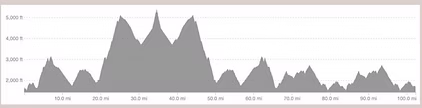
The longest race I had previously done was 57 miles, so the big challenge on this first lap was trying to figure out what it was okay to ask the legs to do and what was an effort that I wouldn’t be able to sustain for the last thirty miles. In any case, I knew that “forgiving” had not been the right word for this section the first time the trail pitched up and the footing was so bad that I had to drop to all fours to scramble up. The two saving graces of this section were that, while the daylight lasted, I had a beautiful view of the sunset from the top of the ridge and a runner in front of me in a bright orange shirt that I could lock on to and just slowly reel in. I had my one interesting encounter with a mountain biker (there were several worse stories that I heard from other runners post-race) when we passed each other while I was going down the backside of a ridge and I realized he was about to pelt downhill, in rapidly fading light, into the runners coming up, but luckily I never had to dodge any knuckleheads while I was climbing.
Once the sun was down, it became extremely difficult to run extended stretches of the course. The problem was not tripping over roots or rocks on the trail, but that the mountain bike trail would dip up and down or make a steeply banked turn that you couldn’t see coming until you were in the middle of it. The constant braking, re-accelerating, and adjusting was challenging with so much distance already covered and descending already done, so I had to ease the pace way down to prevent any really forceful braking. The bending and turning also made it difficult to gauge how far you had gone, but I finally made it through to the fire road that, despite climbing up, made the distance you were covering much more obvious and led up to the Jerdon Mountain aid station. I had learned my lesson from sitting down at previous aid stations, so I moved through pretty quickly.
I didn’t see any other runners for a long time after leaving the aid station, so it was almost bewildering when the leader, who eventually finished only five minutes off of the course record, shot by me with his pacer as they completed their second lap. I didn’t fully understand how someone was moving that fast until I came up on another runner and he explained who it had been. I felt extra bad for this runner, because I’d caught up with him on an extended climb, thinking that I would be okay to run on the incline because a gradual decline would probably follow it. Instead, we were back on the stop-start climbing and turning of another mountain bike trail, and this section was so painful that I was groaning out loud as I tried to manage the legs through it. He eventually pulled away from me, possibly creeped out by the constant moans, but I was able to keep churning out strides and ignoring the pain in my knees to reach the Camp Grier aid station. You run past the eventual finish line to reach the aid station on your first lap, which some runners said they really struggled with, but I liked the feeling on knowing what was waiting for me when I finished the next lap.
“To brave the dark between stars seeking friends” - Miles 84 to 102
The sun had been down for a few hours at this point, so it was time to dress a little more warmly and prepare for the fatigue of continuing through the night. My supplies hadn’t made it to this aid station, but I had my long sleeve base layer in my bag and bummed a couple gels from a friend who was crewing someone else. I had been looking forward to my caffeinated gels after going off coffee for the month before the race, but I eventually convinced myself that half a cup at the Jerdon Mountain aid station would be just as nice. My friend was a little sleep-deprived and flustered by me not having my stuff, but it was actually more helpful just to have someone reminding you that a world still exists outside the pain cave that you’ll get back to you at some point.
Once I was back on my feet and wobbling forward again (my quads had locked up again when I sat down), I joined up with another runner (or hobbler) setting out on his final lap. When he asked me how I was doing, I said something like, “I don’t feel great, but that’s okay. This loop is still getting finished.” He responded, “Wow, that’s inspiring. I’m going to remember that for this loop.” My legs took a while to loosen up and allow me enough range of motion to run, so he initially distanced me, but I eventually caught back up and ran with him for a bit. After a mile or so, he told me to go on ahead, and he pulled to the side and started throwing up. I managed to suppress my initial instinct to tell him it was inspiring and kept pushing forward.
I found the second loop much easier. Part of that was due to being familiar with the trails that lay ahead of me, and another part was knowing that there was now less than a marathon between me and finishing. My running form was still limited by my quads and knees, but I was consistently moving past runners who were still on their first loop, and being able to see those headlights in the night helped me anticipate the trail and break the course into smaller chunks as I chased them down. The guy who had been scared off by my moaning had fallen asleep next to the trail, but he looked so peaceful that I convinced myself that he needed his sleep and I shouldn’t wake him up to check on him. I caught up with my friend who was on his first loop about seven or eight miles into my second, and while I didn’t envy him the distance remaining, he and his pacer were moving at a steady speed and seemed to be in good spirits. I revised that judgment a little after racer when I saw the texts his pacer had been sending to his family about how brutal the course was, but in the moment, it was great to catch my breath for a little bit while getting an update before pushing on. I also passed my therapy buddy from Heartbreaker Ridge who was struggling with his shoe rubbing against the front of his ankle, but there were a few quick-moving headlights behind us on the trail, so I just had to wish him good luck and power up the last stretch to the Jerdon Mountain aid station.
I got my half cup of coffee and some veggie broth down quickly and was headed down the trail again before my legs had too much of a chance to lock up. I found out later that I had passed a couple more runners here that I had been racing all day and just didn’t recognize due to fatigue, darkness, and wardrobe changes. The rolling and banking of the mountain bike trails were still pushing my legs to the limit, but at this point I recognized the “runnable” stretches to push the pace on and the “too difficult” sections that I just needed to hike through as smoothly as possible, and I made good time to the extended climb that I had run up too fast on the previous loop. I paced the climb much better on the second attempt and was able to set off on a run when I turned off the climb and back onto the last three miles of trails. I didn’t think anyone was too close to me, but I still wanted to protect the position I’d spent over a day fighting for, so I was really pushing as the noise of the finish line got closer and closer and the lights of Camp Grier finally came back into view. The sun had just come up, so I got to cross the finish line and see my friends waiting for me back in the light once again.
I could definitely write an even greater number of words about the relationships, old and new, that made the training and racing so enjoyable, but I need to wrap this up before the reading becomes longer than the race itself. To end, I would really recommend Hellbender to anyone considering it, as the course and the people involved are both spectacular, and thank you to everyone who was part of the journey of the finish line.